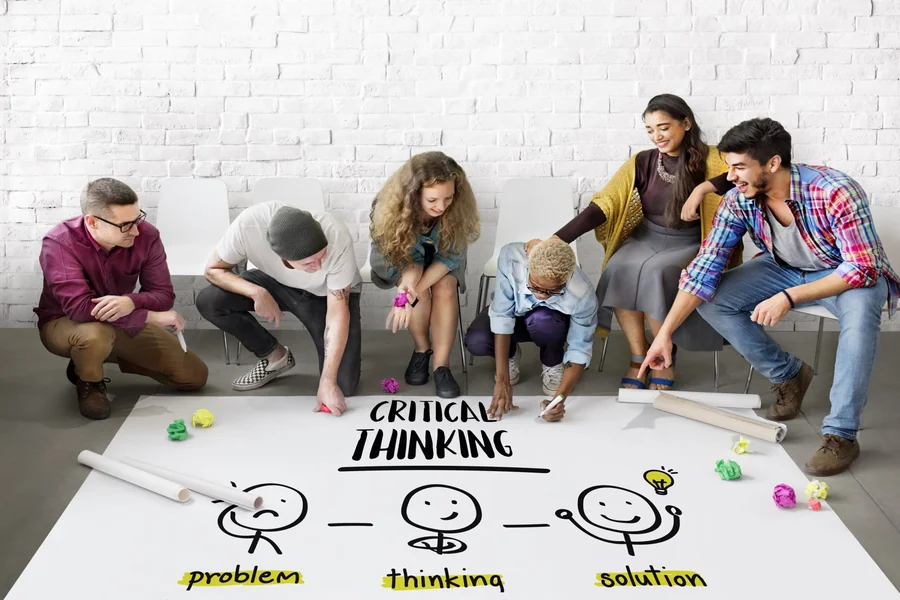
The Importance of Critical Thinking Skills has grown significantly in today’s fast-paced and information-rich world. Every day, people are exposed to a constant stream of opinions, data, and choices, making it essential to think clearly and make informed decisions. Critical thinking is not just an academic skill—it is a life skill that influences how we understand problems, evaluate information, and respond to challenges.
In both personal and professional settings, the ability to analyze situations logically and question assumptions can lead to better outcomes. Instead of accepting information at face value, critical thinkers examine evidence, consider different perspectives, and make thoughtful judgments. This article explores why critical thinking matters and how it can be developed to improve various aspects of life.
Understanding What Critical Thinking Really Means
Critical thinking is often misunderstood as simply being critical or skeptical. In reality, it is about thinking deeply, logically, and objectively. It involves analyzing information, identifying patterns, and making reasoned decisions based on evidence.
A critical thinker asks questions such as: Is this information reliable? What are the underlying assumptions? Are there alternative viewpoints? This approach helps avoid bias and leads to more balanced conclusions.
It also requires self-awareness. Recognizing your own beliefs and limitations allows you to approach problems with an open mind. Instead of reacting emotionally, critical thinking encourages thoughtful responses.
This skill is not limited to any specific field. It applies to everyday decisions, from choosing products to evaluating news and solving workplace challenges. Learn and grow with pressvibepulse com.
The Role of Critical Thinking in Decision-Making
Decision-making is a part of daily life, and critical thinking plays a key role in making better choices. Without it, decisions may be based on incomplete information or emotional reactions.
Critical thinking helps you evaluate options carefully. By weighing the pros and cons and considering possible outcomes, you can make more informed decisions.
It also reduces the likelihood of mistakes. When you take the time to analyze a situation, you are less likely to overlook important details.
In professional settings, strong decision-making skills can lead to improved performance and leadership. Employers value individuals who can think independently and solve problems effectively.
Ultimately, critical thinking empowers you to take control of your decisions rather than relying on guesswork or external influence.
Enhancing Problem-Solving Abilities
Problem-solving is another area where critical thinking is essential. Life is full of challenges, and the ability to approach them logically can make a significant difference.
Critical thinkers break down complex problems into smaller, manageable parts. This makes it easier to identify the root cause and develop effective solutions.
Instead of jumping to conclusions, they explore multiple possibilities and evaluate each one carefully. This leads to more creative and practical solutions.
Critical thinking also encourages persistence. When faced with obstacles, it helps you stay focused and continue searching for solutions rather than giving up.
By improving problem-solving skills, critical thinking contributes to both personal growth and professional success.
Critical Thinking in Education and Learning
Education is one of the key areas where critical thinking plays a vital role. It goes beyond memorizing facts and encourages deeper understanding.
Students who develop critical thinking skills are better able to analyze information, ask meaningful questions, and engage with complex topics. This leads to a more enriching learning experience.
In today’s digital age, where information is easily accessible, the ability to evaluate sources is crucial. Critical thinking helps students distinguish between credible information and misinformation.
It also promotes independent learning. Instead of relying solely on teachers, students become active participants in their education.
Educational systems are increasingly recognizing the importance of critical thinking and incorporating it into teaching methods.
Building Strong Communication and Analytical Skills
Critical thinking is closely linked to communication. When you think clearly, you can express your ideas more effectively.
It helps you organize your thoughts, present arguments logically, and support your opinions with evidence. This is especially important in discussions, debates, and professional settings.
Listening is another important aspect. Critical thinkers pay attention to different viewpoints and consider them before forming conclusions.
Analytical skills are also enhanced through critical thinking. The ability to interpret data, identify trends, and draw conclusions is valuable in many fields.
Strong communication and analytical abilities contribute to better relationships, teamwork, and overall effectiveness.
Developing Critical Thinking in Everyday Life
Critical thinking is not something you are born with—it is a skill that can be developed over time. Practicing it in daily life can lead to noticeable improvements.
Start by asking questions. Instead of accepting information as it is, try to understand the reasoning behind it. This helps you develop a habit of inquiry.
Reading widely and exposing yourself to different perspectives can also enhance critical thinking. It broadens your understanding and challenges your assumptions.
Engaging in discussions and debates encourages you to think more deeply and consider alternative viewpoints.
Reflecting on your decisions and experiences allows you to learn from them. Over time, this strengthens your ability to think critically.
Consistency is key. The more you practice, the more natural critical thinking becomes.
Final Thought
The Importance of Critical Thinking Skills cannot be overstated in a world filled with information and complexity. It is a powerful tool that helps individuals navigate challenges, make informed decisions, and achieve meaningful success.
By developing this skill, you gain the ability to think independently, evaluate situations objectively, and approach problems with confidence. It enhances not only your professional capabilities but also your personal growth.
Critical thinking is not about being perfect—it is about being thoughtful, curious, and open to learning. With consistent effort and practice, anyone can strengthen this skill and benefit from its long-term impact.
In a rapidly changing world, critical thinking is not just an advantage—it is a necessity for making sense of the world and shaping a better future.
FAQs
What is critical thinking?
Critical thinking is the ability to analyze information, evaluate evidence, and make reasoned decisions.
Why are critical thinking skills important?
They help improve decision-making, problem-solving, and the ability to evaluate information effectively.
Can critical thinking be learned?
Yes, critical thinking can be developed through practice, questioning, and exposure to different perspectives.
How does critical thinking help in education?
It helps students understand concepts deeply, evaluate information, and become independent learners.
What are simple ways to improve critical thinking?
Asking questions, reading widely, engaging in discussions, and reflecting on experiences can improve critical thinking skills.