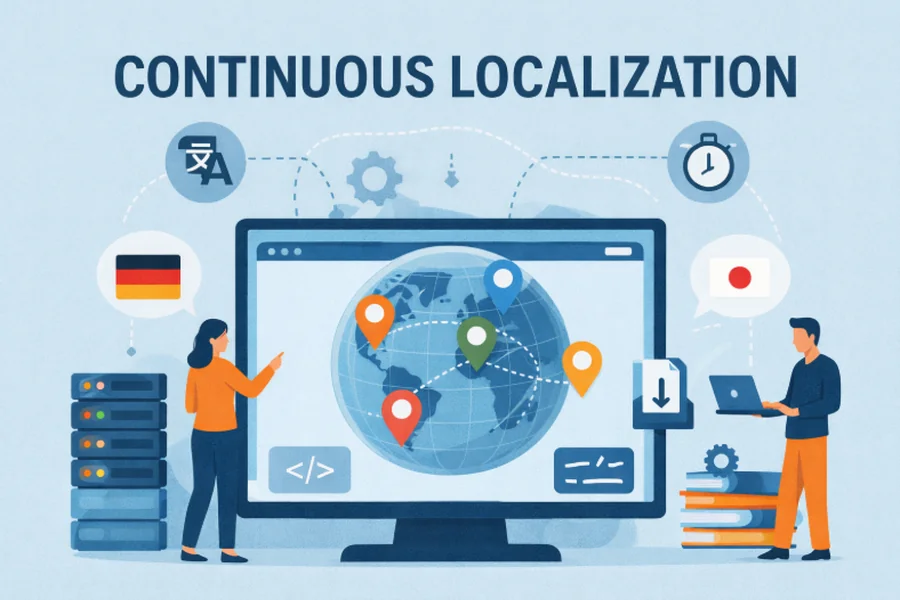
The global digital economy is constantly evolving, and software products, websites, and applications are continuously changing. Agile development methodologies and continuous delivery pipelines allow teams to ship updates weekly – or even daily. As products expand into international markets, however, one major challenge consistently emerges: keeping localized content aligned with rapid development cycles.
Traditional localization models, which rely on manual handoffs and periodic translation batches, struggle to keep up with this pace. They introduce delays, create version mismatches, and often turn localization into a bottleneck rather than a growth enabler. This is where continuous localization changes the paradigm.
Instead of treating translation as a final step, continuous localization embeds it directly into the product development lifecycle. Localization becomes automated, incremental, and fully synchronized with product updates – ensuring that global users always receive the latest version of the experience, in their own language.
What Is Continuous Localization?
To understand what is continuous localization, it helps to look at how modern software teams operate.
Continuous localization is an automated, ongoing localization workflow where new or updated content is translated, reviewed, tested, and delivered as soon as it is created. Rather than waiting for large translation projects to be assembled, localization happens continuously – often in near real time – as developers push changes to the product.
This approach tightly integrates localization with code repositories, CMS platforms, and CI/CD pipelines. Whenever new strings or content updates appear, they are automatically detected and routed through predefined translation workflows. Once approved, localized files are synced back into the product and deployed alongside the original update.
At a high level, continuous localization enables teams to:
- Translate content immediately after it’s created
- Automatically sync localization files across tools and repositories
- Review translations in real product context
- Run automated quality checks across languages
- Release multilingual updates simultaneously
By aligning localization with agile development practices, companies eliminate the historical gap between product updates and translated releases.
How Continuous Localization Works in Practice
Continuous localization relies on deep technical integration and automation. While implementations vary, most workflows follow a similar structure.
Integration with Development Environments
Localization platforms connect directly to version control systems such as GitHub, GitLab, or Bitbucket. When developers commit new or updated content, translatable strings are automatically detected and extracted.
Automated Content Extraction
Instead of manually preparing translation files, the system continuously monitors repositories and content sources. New strings are captured instantly and sent to the localization platform without human intervention.
Translation and Workflow Automation
Once content is detected, translation workflows start automatically. Depending on configuration, strings may be translated using machine translation, human linguists, or a hybrid model. Translation memories and terminology databases ensure consistency and reduce repetitive work.
Review and Quality Assurance
Automated QA checks verify formatting, placeholders, character limits, and consistency. Linguists and reviewers can preview translations in context, reducing UI issues and layout problems before release.
Continuous Deployment
Approved translations are pushed back into the repository automatically. From there, CI/CD pipelines deploy localized content together with the original update – often multiple times per day.
Feedback and Optimization
Because localization is continuous, teams can respond quickly to feedback. Translators, developers, and QA specialists collaborate through shared dashboards, improving quality with each iteration.
Key Benefits of Continuous Localization
Faster Global Releases
Localization happens in parallel with development, enabling simultaneous launches across all markets.
Shorter Time-to-Market
Automation removes manual delays, allowing teams to expand internationally without slowing product velocity.
Operational Efficiency
Repetitive tasks are handled automatically, freeing teams to focus on quality, UX, and strategy.
Cost Optimization
Incremental updates, translation memory reuse, and selective human review significantly reduce long-term localization costs.
Consistent User Experience
All users – regardless of language – receive updates at the same time, reinforcing brand consistency and trust.
Seamless DevOps Alignment
Localization becomes a natural extension of CI/CD workflows rather than a separate operational process.
Scalable Growth
Adding new languages or markets requires minimal additional effort once the system is in place.
Frequently Asked Questions
How is continuous localization different from traditional localization?
Traditional localization happens after development and often causes delays. Continuous localization runs alongside development, keeping translations in sync with every release.
Is continuous localization only for large companies?
No. Thanks to cloud-based tools and automation, startups and mid-sized teams can adopt continuous localization just as effectively as enterprises.
How does it support agile development?
Agile teams release frequently. Continuous localization mirrors that cadence by updating translations incrementally instead of in large batches.
Does machine translation replace human translators?
No. Automation handles speed and scale, while human linguists focus on quality, nuance, and cultural accuracy.
What types of content work best with continuous localization?
It’s ideal for UI text, product content, documentation, and support materials – any content that changes frequently.
Final Thoughts
Continuous localization reflects a broader shift in how global digital products are built and delivered. By embedding localization into the development pipeline, companies move from reactive translation models to proactive, scalable global operations.
Instead of slowing innovation, localization becomes an invisible engine that powers international growth – ensuring every update, feature, and message reaches users everywhere, at the same time, and in the right language.
For modern, globally minded teams, continuous localization is no longer a forward-looking concept. It’s the standard for sustainable global product delivery.