Introduction
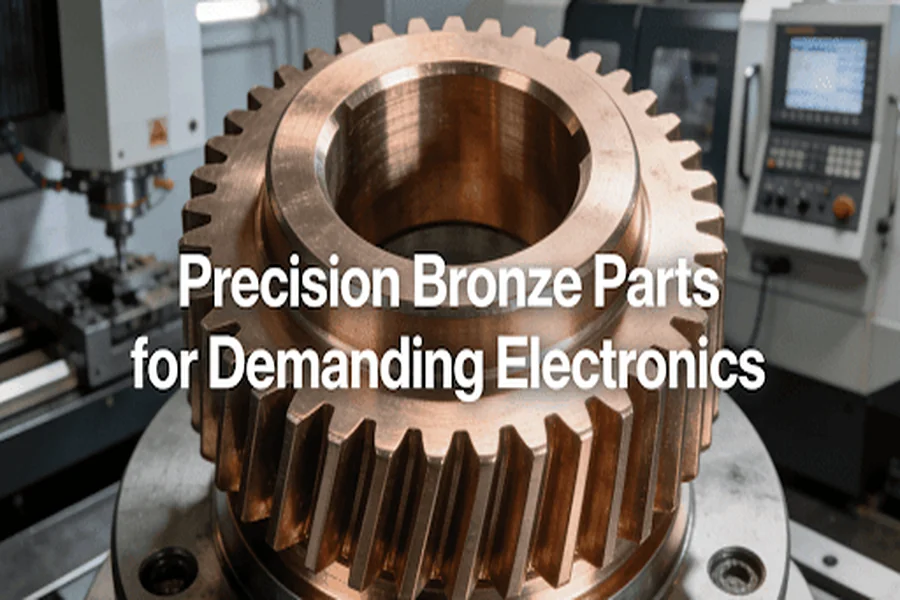
The consumer electronics industry always aims for thinner, lighter, and more powerful devices. In front of that, there is a huge challenge: the increasing susceptibility of mobile device parts to wear and tear, combined with long production cycles, drives up costs and exasperates customers. At the heart of the problem is the limitation of the more traditional manufacturing approaches, including injection molding, which usually does not achieve precision enough for complex geometrical features but with limited material choice.
This article introduces bronze CNC machining bronze as a disruptive solution. Offering high-precision cutting and rapid prototyping services, it optimizes both the performance of a part and the entire workflow. The subsequent analysis discusses how bronze CNC machining is going to reshape electronics manufacturing.
How Does Bronze CNC Machining Enhance the Durability of Mobile Device Parts?
The lifespan of consumer electronics can be linked to the lifespan of the internal and external parts thereof. Bronze CNC machining serves the vital need by leveraging the inherent properties of the materials along with the manufacturing process.
Material Science of Bronze – A Background for Sustainability
Bronze alloys, such as phosphor bronze and aluminum bronze, have some inherent properties that make them the best for challenging uses in the manufacturing of Consumer Electronics Manufacturing. For example, the alloys are highly corrosion-resistant, meaning that they can resist the corrosive nature of sweat, moisture, and other environmental factors. Additionally, the alloys have high thermal conductivity and wear resistance. According to an ASM International report on the properties of bronze, this makes the alloys ideal for the production of connector sleeves, heat sinks, and high-stress hinges since the resulting products will last longer without failures.
Precision Manufacturing: Turning Potential into Performance
The potential benefits of bronze can only be harnessed with accurate manufacturing and machining processes. CNC Machining Bronze is a critical process in the manufacture of premium CNC machining bronze parts.
- Designing for Minimum Wear
Contrary to the casting process, the product created from CNC machining technology possesses high finishing qualities and accurate dimensions. For example, if a smartphone camera focus system or the hinge in a foldable smartphone requires a high degree of smoothness, then the interaction between the machined bronze parts and the other components would have a low coefficient of friction, thus increasing the longevity of the product.
- Accelerating Development Cycle
Rapid Prototyping Services offered during the design process allow the engineer to have functional prototypes of the bronze design in a few days. The process eliminates the need for extensive testing of the durability of the design for its feasibility of use. The design can therefore undergo several revisions before mass production for testing of its durability.
If you would like more information about what this process can do, you might find it helpful to look at this resource: CNC Machining Bronze.
Why is Bronze CNC Machining Better Suited for Consumer Electronics Manufacturing Than Traditional Methods?
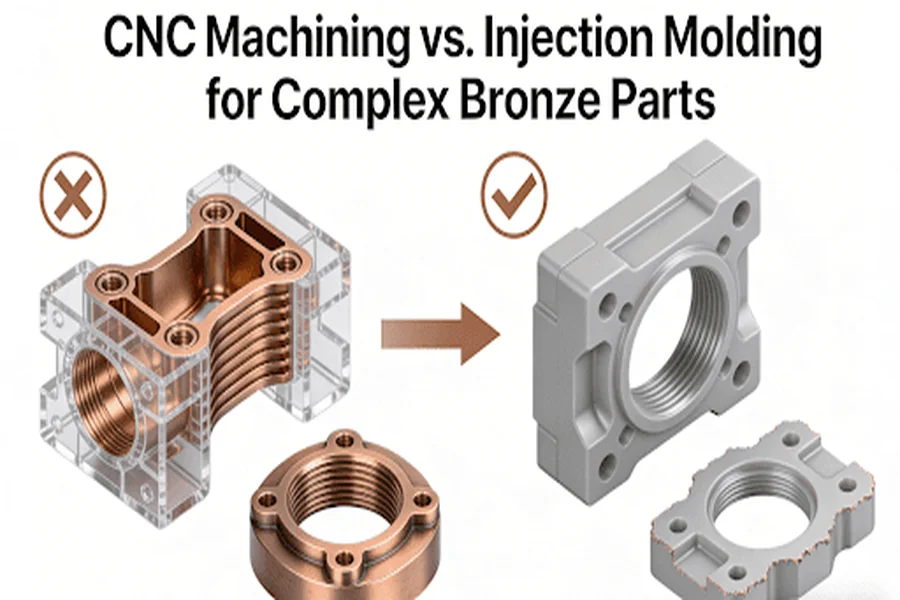
With increased complexity in the design of consumer electronics and shorter product life cycles, conventional techniques such as injection molding and casting are found to lack efficacy. bronze CNC machining proves to be a much more effective alternative with unmatched precision and versatility that are required in technology integration solutions.
Whilst the main benefit associated with the usage of CNC machining as opposed to other moldings is the absence of an expensive mold, which facilitates direct production from a computer design, there is a tablet data connector with a bronze shielding requirement coupled with a need for a bronze contact with a tolerance level of ±0.01 mm whereby even the main benefit associated with the usage of CNC machining is fulfilled because the process is capable of creating a precise location for the contacts necessary for proper data transmission while at the same time allowing the incorporation of the bronze shielding within the body of the connector as a result of proper technology integration solutions.
An Institute of Electrical and Electronics Engineers white paper on the topic of electronics manufacturing verifies that although the up-front unit cost of CNC machining may be slightly greater, the benefits of lowered material waste, accelerated time-to-market, and the elimination of mold costs make the overall cost of ownership of CNC machining superior in the case of low to medium volume, complex parts. A manufacturer that is ISO 9001 compliant ensures that every piece of bronze CNC inventory is of the quality necessary for the overall reliability of the electronics market that the electronics demand and require.
How Does Bronze CNC Parts Processing Optimize Production Costs and Efficiency?
Controlling costs, thereby optimizing throughput, is the key for any consumer electronics manufacturing business. Implementing the strategic concept of bronze CNC machining can provide an option to optimize the entire cost structure without compromising on the quality parameters.
Understanding Investment – More than the Cost of a Single Machine
Investment refers. The purchase price of high-accuracy equipment (cost of CNC machine price) is a substantial investment. However, the purchase price is spread over the long-term value created. To a manufacturer, it opens up higher-value and precision-based projects. To a brand, it opens up their products to reliable and innovative components.
Efficiency Enhancement Strategies – from Prototype to Volume Production
The initial step in the process for maximizing efficiency begins by taking advantage of the rapid prototyping services for rapid validation of the design, which helps avoid expensive mistakes from being carried along in the full production process. Throughout the full-scale production process, the biggest gains in efficiency come from smart CAM programming techniques that employ optimal cutting conditions and optimize the machining of CNC machining parts.
- Case Study – Reducing Scrap to Save Costs
In the case of a wearable device maker, the scrap pable rate of the traditionally cast bronze crown was found to be around 8%. However, this rate dropped considerably to below 0.5% after the adoption of CNC machining, where accurate removal of material takes place, hence resulting in a reduction in material scrap page that in turn counteracts some of the machining costs incurred.
- Cost Amortization in Batch Production
For production runs of standardized components or larger quantities of parts annually, CNC machining can offer unit economies when done with optimal nesting. As the production quantity rises, CNC machining becomes highly economical, particularly when done in the hundreds of units.
The Total Lifecycle Cost Perspective
A comprehensive cost analysis needs to look beyond the initial cost of manufacturing that has been quoted. The reliability and long life offered by bronze CNC parts mean there are lower warranty charges, and this has a significant “hidden” cost saving factor attached to it. To know more about cost savings strategies for your project, visit our precision machining services .
What is the Key Role of Bronze CNC Machining in Rapid Prototyping Services?
Fast Rapid Prototyping Services fill the gap between the concept and the reality of product design. For the case of electronics with high-performance metals, the role of CNC machining bronze parts is paramount during this process.
Contrary to 3D-printed plastic prototypes, functional prototypes made using CNC machining and bronze offer a wide range of functionality. This is because the prototypes are made from the final production material, having the exact properties, conductivity, and electric properties as the final production component. With bronze heat spreaders, for instance, in a gaming smartphone, functional prototypes produced through CNC machining take merely weeks to test, as opposed to months in the earlier design validation process. This is because functional prototypes made from bronze via CNC machining offer exact results in terms of functionality.
Furthermore, as the Consumer Electronics Manufacturing sector emphasizes sustainability, bronze stands out as a fully recyclable material. Swarf generated during CNC processing can be directly recycled, aligning with green manufacturing principles. While CNC machine brass is also common for prototypes, bronze is often preferred for critical components requiring higher strength, wear resistance, and corrosion resistance.
How to Achieve High Precision and Consistency in Bronze CNC Machining?
In the case of critical Mobile Device Parts that call for micron-level accuracy, CNC precision machining is the process that ensures a certain level of accuracy through systematic process control. Precision bronze CNC machines permit positions at the micron level, and CAD/CAM computer software also adjusts for machine/tool wear and material stresses.
Furthermore, after machining, Coordinate Measuring Machines (CMM) carry out whole-dimensional scanning checks to ensure that the parts do meet the necessary requirements, and any deviations are simultaneously corrected. Such parts, therefore, conforming to standards set in IATF 16949 and AS9100D, yield the highest level of reliability in the most premium electronics products and must do so every time.
Conclusion
The CNC machining of bronze materials represents a reliable, accurate, and inexpensive method of production within the field of consumer electronics. With the ability to create parts that have a high level of durability and complexity, and the capability to integrate well with rapid prototyping, this technology allows companies to create and innovate quickly and efficiently. This provides a bright outlook for an industry that is led by innovation and advancement.
Author Biography
The author is a specialist in the field of precision manufacturing with extensive experience. Their expertise focuses on CNC technologies and material science, providing industrial solutions to a global clientele.
FAQs
Q1: What are the distinguishing benefits of bronze CNC machining?
A: Bronze CNC machining also boasts high wear resistance properties and superior thermal conductivity, making it the best metal for the production of electronics. This improves the durability of the product by offering more than 20% savings in maintenance costs over time.
Q2: How are the prices of bronze CNC components determined?
A: This depends on the amount of material required, machine hours, as well as the design complexity. By making use of the rapid prototyping facility to optimize the design, the unit price may very well become competitive. A formal quote will give the best price.
Q3: How is bronze different from brass in CNC machining?
A: Bronze provides increased corrosion resistance, whereas brass is more machinable. Bronze may be preferred over brass for high-load applications for sensitive electronic components because of the delicacy required in the latter for optimal performance.
Q4: Can bronze CNC machining be applied for small-batch production?
A: Yes, rapid prototyping functions effectively in small batch orders, which makes it possible to change designs flexibly. With the integration of high advanced technology, efficiency can be comparable even for large production orders.
Q5: What ensures the quality of the bronze CNC parts?
A: Quality is guaranteed through ISO process certification, such as precision in controlling the tolerance of 0.005mm. Choosing the right supplier in terms of certification is important in preventing flaws in the components.