Introduction
In today’s competitive manufacturing environment, businesses face challenges such as cost overruns, delivery delays, and quality discrepancies in CNC milling projects. This is primarily due to the absence of systematic knowledge about the types, costs, and application of CNC milling.
This Handbook provides a comprehensive roadmap for scientifically selecting milling processes in accordance with industry standards. With this issue addressed using data-driven solutions, it enables our target audience to overcome common potential risks. Below are points organized into sections, explaining key aspects using case studies.
What Are the Main Types of CNC Milling and Their Uses?
CNC milling employs different techniques depending on the industry involved, and as described in customized CNC milling services, the type of service should be selected based on the complexity of the material, which is crucial for determining the appropriate technology for the project.
1. Vertical CNC Milling: Simplicity & Accuracy for Regular Components
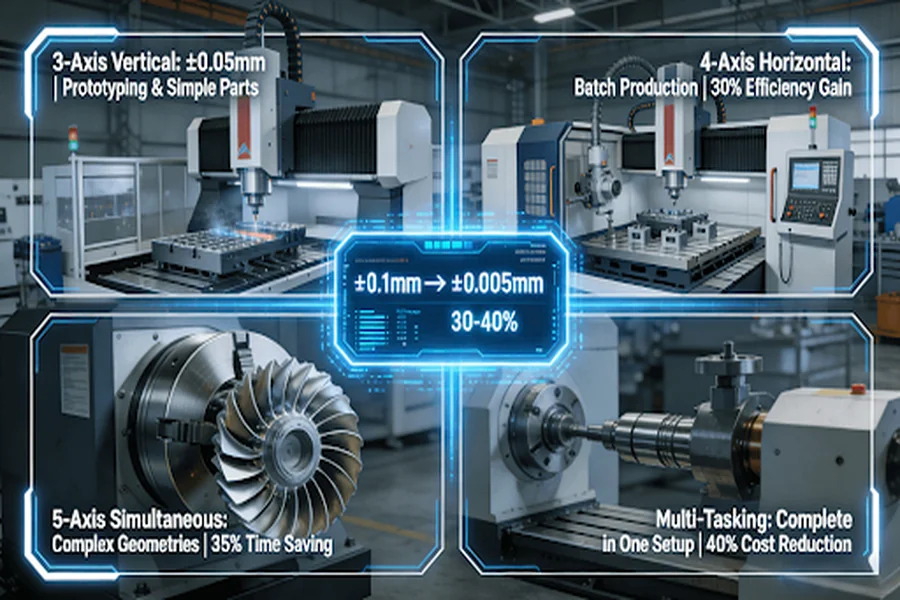
The spindle of a vertical milling machine is positioned perpendicularly and is useful when performing plunge cuts and drilling. Vertical milling machines are suitable when manufacturing components with relatively low complexities that demand high precision. For example, in the aircraft industry, vertical milling machines are employed when manufacturing light brackets with tolerances of ±0.05mm. Catering to ISO 9001 standards guarantees that purchased items are of equal quality from different suppliers because certified suppliers use standardized methods that reduce mistakes made when manufacturing items. They are cost-effective and are mostly used in prototyping and low-scale production.
2. Horizontal CNC Milling: High Volume Efficiency and Complex Cavities
Horizontal mills have a horizontal spindle configuration that allows for multi-face machining. They are ideal for high-volume production categories like automotive because they are required to have deep cavities and undercuts in the manufacture of engine blocks or transmission parts. This group of mills uses ASME Y14.5 geometric tolerancing to ensure precise dimensionality. One of the benefits of horizontal milling is that it cuts production cycles by 30% because it can produce in batches.
3. 5-Axis CNC Milling: Mastering Intricate Geometries and Single-Setup Precision
Additionally, the introduction of 5-axis machining in milling provides two axes for rotary movements, which ensures dynamic tool positioning and orientation for the production of complex parts and free-form surfaces. The need for multiple setups within 3-axis machining results in a compound error, which is undesirable. The medical device industry employs 5-axis machining in the production of titanium, which has specific contours that mimic human anatomy, in accordance with ISO 13485. Moreover, this process provides over 35% improved processing time and increased flexibility in designing.
In What Ways Can Manufacturers Improve CNC Milling for Specific Sectors, Such As Automobile or Medical Use?
Application-specific optimization also includes customizing milling methods in accordance with the requirements of a given industry, based on the material that is used.
1. Automobile Industry: Overcoming Challenges in Creating Components with High Strength and Small Tolerances
Auto parts, such as brake calipers or suspension pieces, demand materials with high strength qualities, such as hardened steel or aluminum alloys. Optimization will be achieved using complex tool paths, preventing heating issues as well as deformations. ASME Y14.5 specifications will be used as a means of geometric tolerance with + or -0.02 mm specifications for critical parts. DFM integration will ensure material reduction of up to 15% using simplified designs, which will also quick-start the time-to-market process.
2. Medical Devices: Guarantees of Ultra Precision and Biocompatibility
Medical parts, be it surgical equipment or implants, must have precision on the micron level and be made of biocompatible materials that are biologically compatible with human tissue and can be titanium or PEEK. This can be achieved by the following optimization methods: five-axis milling to produce complex shapes and in-process inspection according to guidelines in ISO 13485. Feedback can be in the form of closed-loop monitoring to guarantee surface roughness values of below 0.4 µm.
3. Cross-Industry Strategies: Leveraging DFM and Software Integration
Optimization in every industry relies upon the principles of DFM and CAD/CAM software. By taking into account parameters such as wall thickness in the design phase, industries can reduce costly modifications. CAD/CAM software helps in the simulation of tool movement, thus eliminating potential collisions. As a result, efficiency increases by 25%. Mention in the ISO 9001 guidelines of the clauses for innovation makes it clear that standardized procedures facilitate adaptive manufacturing.
What Factors Influence the Price of CNC Milling and How to Analyze Them for Budget Control?
Cost control in the CNC milling process involves the analysis of the breakdown of the costs to avoid the occurrence of expenditures over and above what has been budgeted for.
- Direct Cost Elements: Machine, Tooling, Materials, and Labor: Direct costs include machine depreciation, tool wear, material costs, and operators. For instance, machining aerospace aluminum is more expensive in terms of material compared to machining aluminum, and one of the benefits of DFM is that it reduces material costs through the reduction of material waste. Principles of cost management in ISO 9001 include the reduction of waste in terms of defined processes.Correct selection of machining tools, such as the use of carbide tools when machining hard material, extends the life of the tools and reduces the cost of parts up to 20%.
- Indirect Factors: Setup Time, Scrap Rates, and Maintenance: The budget can be affected by the complexities of setup and scrap rates, which can be indirectly related. Various setups for the 3-axis milling machine increase labor and the chances of errors, which can be reduced by 30% with single-piece machining performed by a 5-axis machine. Predictive maintenance, which follows ISO 9001, reduces machine downtime and thereby shortens machine life. Data analysis regarding scrap rates, such as through Statistical Process Control, indicates the areas requiring correction.
- Practical Budget Analysis: ROI Calculation and Batch Optimization: Manufacturers may utilize the ROI models available for assessing the return on investment for milling. Taking the initial investment costs of 5-axis machining equipment compared to the in-depth costs saved by setting up fewer setups, the payback occurs in two years. Batch segmentations to optimize parts reduce costs per item by 15% for economies of scale. Quotations with transparency in costs, as depicted by industry-standard companies, help avoid extraneous costs.
How to Choose a Trustworthy Supplier for CNC Milling Services with Certifications and Competencies?
Supplier selection involves the process of making assessments based on certifications, skill sets, and previous success.
1. Key Certification Standards: ISO 9001, AS9100D, and Industry Mandates
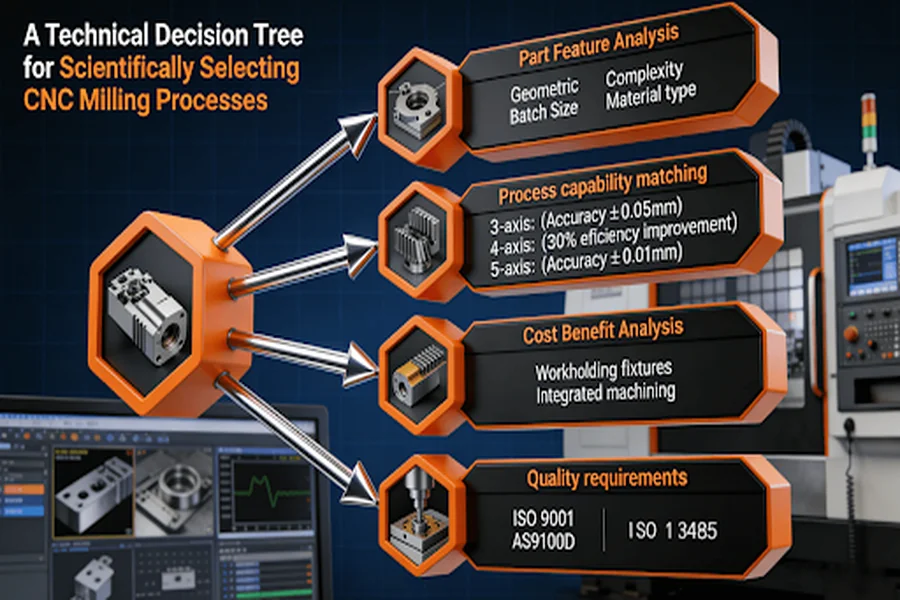
ISO 9001 certification and AS9100D certification related to quality management and Aerospace are keys to ensuring strict procedures are followed. These two documents are documented, traceable, and operate on continuous improvement initiatives, thereby eliminating any variation in procedures and processes. Also, when it comes to the health industry, ISO 13485 certification is a must-have because it proves strict measures are followed regarding biocompatibility and sterilization procedures at suppliers.
2. Technical Capabilities Assessment: Equipment Precision and Case Studies
Assess the supplier’s technical abilities through the evaluation of the machine park, for instance, the presence of 5-axis CNC machines that can achieve a tolerance of ± 0.01 mm. “Case studies of complex part production, including aerospace parts with deep cavities, are a good way to verify expertise in this area.” Satisfaction of the ASME Y14.5 standards ensures that the supplier is capable of dealing with geometric tolerances.
3. Supplier Evaluation Checklist: A Step-by-Step Guide
Create a checklist that includes aspects of certification and validity, age of equipment, customer feedback, and inspection of sample parts. The supplier could be queried regarding the use of real-time monitoring systems for quality checks, for example. This is a proactive approach that allows a company to steer clear of suppliers with varying levels of quality, thereby reducing costs and increasing efficiency according to ISO 9001 standards.
What Are the Common Challenges in CNC Milling Projects and How to Overcome Them?
The usual challenges encountered by humans, such as tool wear and design defects, can cause project failure, but the answer lies in strategic solutions.
1. Tool Wear and Breakage: Predictive Maintenance and Material Science
This results in low surface finishes and dimensional errors due to the degradation of the tool. The use of predictive maintenance techniques by monitoring the spindle load/vibration with the aid of sensors will decrease downtime by 40%. Material choices for the tools, such as the use of polycrystalline diamond (PCD) for abrasive composites, will improve their lifespan. ISO 9001 protocols are implemented regarding the maintenance of the machining system.
2. Material Deformation and Thermal Issues: Cooling Strategies and Process Control
The most important are thermal expansions of parts, which can cause considerable distortions, especially in thin-wall design cases. Such could, for example, be addressed by the use of coolant-fed tools or, more commonly, by adjustment of the cutting parameters to minimize heat generation. In medical device milling, material integrity is assured by controlled temperature; adherence to ASME Y14.5 ensures dimensionality stability, while DFM principles ensure the geometries are simplified to minimize stress concentrations.
3. Design Flaws: How to implement DFM to avoid rework
Poor designs lead to costly reworks and delays. Early DFM collaboration between designers and manufacturers pinpoints issues, such as inaccessible features or excessive tolerances. Simulating manufacturability with CAD software reduces design iterations by 50%. The case studies exemplify that projects with integrated DFM guarantee cost savings of up to 20% due to material waste and machining time reductions.
How Much Value Do Advanced Technologies Like 5-Axis Milling Bring to Manufacturing Efficiency?
Advanced technologies revolutionize milling by raising its precision and reducing operational overhead.
- Single-Setup Machining: Reducing Errors and Saving Time: 5-axis milling enables complete machining in one setup, eliminating repositioning errors. For example, a turbine blade that required 18 hours with 3-axis methods can be finished in 11 hours with 5-axis, improving accuracy by 35%. The same approach will be applied to conform to the principles of the ISO 9001 standard by giving rise to standardized processes with reduced variability and, therefore, is ideal for high-mix productions.
- CAD/CAM Integration: Optimized Toolpaths and Collision Avoidance: Advanced CAD/CAM software generates efficient toolpaths that minimize idle time and tool wear. Simulation features detect collisions before machining, cutting scrap rates by 25%. Reference to the ASME Y14.5 ensures software outputs meet geometric tolerancing requirements, further enhancing reliability for complex parts such as impellers or prosthetics.
- Smart Manufacturing: IoT & Data-Driven continuous improvement: The IoT-based mills have condition monitoring for the spindle and energy, which makes it possible for the project to have predictive analysis for maintenance. Industry 4.0 ensures reduced downtime by 30% and better resource planning. The standards developed from ISO 9001 ensure traceability, such that the industry can evaluate performance and improvements made in the project.
Conclusion
In order for CNC milling to work effectively, it is necessary that there be a systematic way of selecting, using, and managing the cost of different types of milling machines and cutting tools. In this way, by following standards and technology, and estimating suppliers, companies can avoid mistakes when they perform this process.
FAQs
Q1: It usually takes how many days for custom CNC milling services?
A: The lead time will depend upon the complexity and average projects take 1-2 weeks. Variables such as material availability and verification of designs may affect this. Companies having ISO 9001 certification ensure easier lead time.
Q2: How does material chosen influence costs associated with CNC milling?
A: Cost is directly affected by the hardness of the material used or the availability of the material; for instance, aluminum is less expensive than titanium. Cost savings of 15% may be achieved through the optimization of material choice by DFM.
Q3: What certifications may a CNC milling supplier hold?
Q: The major certification standards include ISO 9001, which is a quality certification; AS9100D, which is related to aerospace; and IATF 16949, which is related to the automotive sector.
Q4: Does CNC milling support complex shapes?
A: Yes, such as 5-axis or multi-tasking machines, which will give a complex part with tight tolerance. Examples include implant components, aerospace, which requires sophisticated programming.
Q5: How to get an accurate CNC milling quote?
A: Offer detailed drawings, specifications of materials, and quantity estimates. Reliable suppliers will use computerized systems for pricing, so there will be no hidden charges.
Author Bio
The author of the article is an expert in precision manufacturing for LS Manufacturing, a company that assists engineers and businesses in dealing with the challenges of CNC milling in the aerospace, medical, and automotive fields. Certified in ISO 9001 and AS9100D, the company provides high-quality, cost-effective assistance using the latest technology and DFM in precision manufacturing. For individual assistance, the author can be contacted for a free project review and transparent CNC milling quotes.