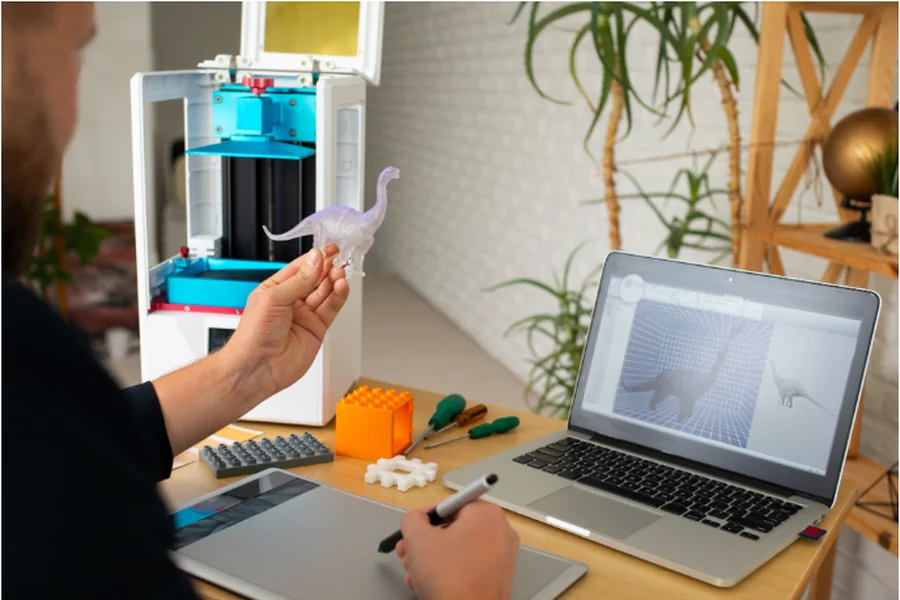
Plastic 3D printing is changing how products are designed and built. What once took long production cycles can now happen in a matter of days. Teams can test ideas faster, fix mistakes early, and bring better products to market without high costs. It also gives designers more freedom to create shapes and features that were difficult with traditional methods. From early concepts to final parts, plastic 3D printing supports every stage of product development. In this article, we’ll explore how it is reshaping modern workflows and why more companies are adopting it to stay competitive.
Rapid Prototyping and Iteration: Why Plastic 3D Printing Services for Product Development Are Leading the Way
The gap between sketching an idea and holding something physical has never been smaller. Rapid prototyping didn’t just change timelines it changed how product teams think about risk.
Drastically Cutting Time-to-Market with 3D Printing
Injection mold tooling used to cost tens of thousands of dollars and eat six to twelve weeks off your calendar. That’s before you’d even produced a single testable part. With plastic 3D printing, that same component lands in your hands within days. You can run multiple design iterations in the time it once took to finalize one. When you can order plastic 3D printed parts online and work with Plastic 3D printing service specialists, you skip the tooling entirely. Each design cycle gets shorter, and the friction throughout development quietly disappears.
Customization at Scale: What Custom Plastic 3D Printing Companies Actually Deliver
Speed matters, but customization is where the real competitive separation happens. Custom plastic 3D printing companies today handle everything from single medical device prototypes to limited-run automotive components and they make on-demand production genuinely practical. Consumer electronics teams are testing product variants in parallel rather than sequentially. Before additive manufacturing hit its current stride, that kind of simultaneous development was rarely feasible for anyone without deep capital.
Material Revolution: Choosing the Best Plastic Materials for Functional Prototypes
Once you’ve got iteration speed and on-demand flexibility working for you, the next critical decision is material. And honestly? This is where a lot of teams leave performance on the table.
Sustainability Is Entering the Conversation Seriously
Forward-looking teams aren’t just asking what a material can handle. They’re asking whether it aligns with broader sustainability commitments. Recycled PLA and bio-based filaments are gaining real traction, and the efficiency case is compelling: additive manufacturing can reduce material waste by up to 95% compared to traditional subtractive methods. Circular production models, where unused material gets reprocessed into new filament, are quietly becoming a differentiator for manufacturers who care about their footprint.
Breaking Down the Cost of Plastic 3D Printing Parts: What Actually Moves the Needle
Once you understand your material options, the next conversation is about the budget. Specifically, the full, loaded cost of plastic 3D printing parts not just the quoted line item.
Where Hidden Costs Like to Hide
Material, print technology, batch size, post-processing, and shipping all influence final pricing. Plenty of startups get caught off guard by finishing costs that never showed up in the initial quote. The custom plastic 3D printing companies worth working with provide transparent, itemized pricing upfront. No surprises mid-project. That kind of clarity matters when you’re managing tight development budgets.
The ROI Case Against Traditional Manufacturing
When you stack 3D printing costs against traditional manufacturing, the numbers get interesting fast. Eliminating tooling alone saves thousands per prototype cycle. For short runs under 500 units, plastic 3D printing almost always wins on total cost when setup, tooling, and iteration expenses enter the equation.
Ordering Plastic 3D Printed Parts Online: What Efficient Teams Actually Do
Understanding cost is one thing. Knowing how to place a smooth, fast order is another.
How the Online Ordering Process Actually Works
Most platforms follow a clean path: upload your STL or STEP file, choose material and finish, review instant design-for-manufacturability feedback, approve the quote, and confirm production. Simple in theory, but when you order plastic 3D printed parts online, clean file preparation makes a real difference. Correct geometry, appropriate tolerances, proper wall thickness get those right, and you avoid delays, rejected orders, and the frustration of resubmitting.
Digital Inventories and Distributed Networks
Smart supply chain teams are going further. They store parts digitally, print on demand rather than carrying inventory, and tap distributed local production networks to shave lead times even further. It’s a leaner, more resilient approach that traditional warehousing simply can’t match.
Common Questions About Plastic 3D Printing for Product Development
1. Which industries benefit most?
Medical devices, consumer electronics, automotive, robotics, and aerospace lead the pack. These sectors demand fast iteration, precise tolerances, and custom geometries exactly where plastic 3D printing outperforms conventional methods.
2. What file formats work best for online orders?
STL and STEP are the most widely accepted. STEP files tend to retain greater geometric accuracy for complex assemblies. Always verify wall thickness, manifold geometry, and unit settings before uploading.
3. How do leading providers handle quality assurance?
Top custom plastic 3D printing companies use dimensional inspection tools, calibrated equipment, and formal process documentation. Many hold ISO 9001 certification, meaning quality management systems are independently audited across every production run.
Where to Go From Here
Plastic 3D printing isn’t a passing trend you can afford to monitor from the sidelines. It’s an active production reality that is reshaping how teams prototype, test, and ultimately ship products. The advantages are real, the tools are accessible, and the competitive pressure isn’t slowing down. Whether you’re running your very first prototype or scaling a full product line, working closely with plastic 3D printing services for product development gives your team a legitimate edge. Reach out to a specialist, get your next idea into physical form, and move faster than you thought was possible.