Work today moves faster than ever, yet most teams still spend hours on manual updates, status checks, and coordination tasks that add no real value. The irony of modern productivity is that even with countless tools, people often work harder just to stay aligned. True efficiency doesn’t come from more apps—it comes from connected automation.
A CRM app helps businesses understand customers, but growth depends on what happens next—how those insights travel across departments and turn into action. That’s where connected platforms like Lark redefine what “working smart” actually means. When automation is woven through communication, planning, and analysis, work becomes effortless. Teams no longer chase updates; updates find them.
The hidden strength of automation isn’t in replacing people—it’s in releasing them from routine.
Lark Base: The engine of an intelligent workflow
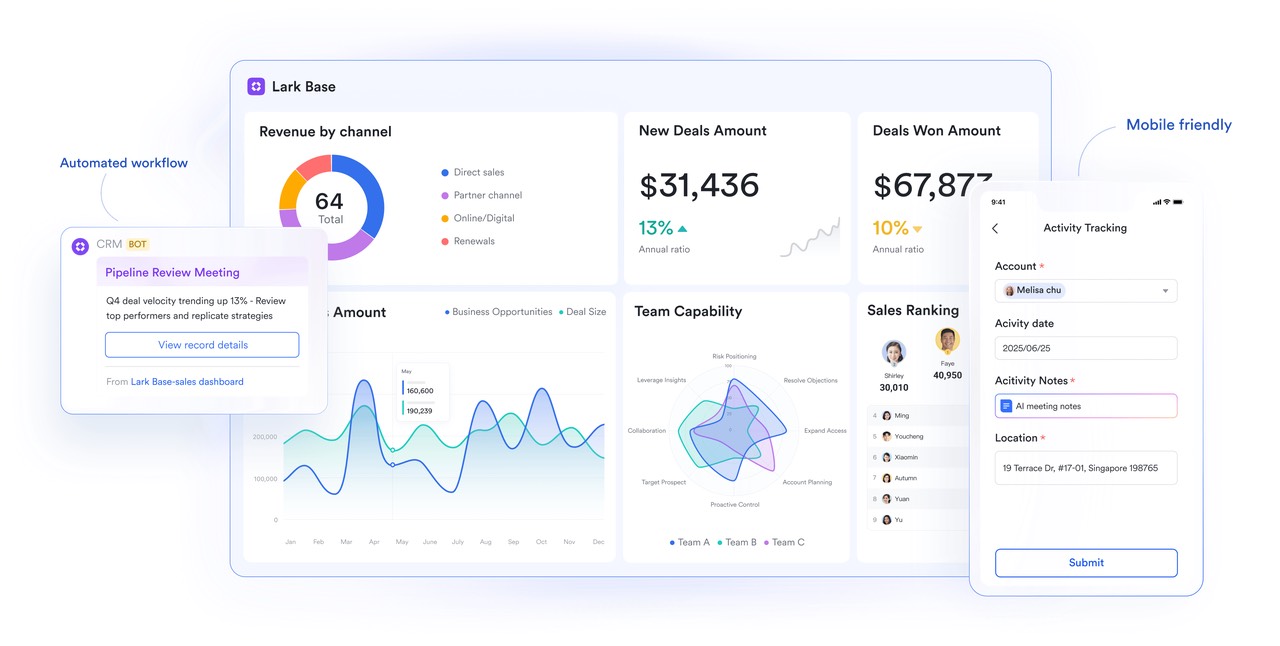
Every automated process starts with a foundation, and Lark Base is that foundation. Lark Base transforms data into dynamic workflows where every update sparks real action, especially for teams managing complex client or operational pipelines in their current CRM software.
Consider a product team managing release cycles. Each feature request, timeline, and approval stage is tracked in Base. When a feature moves from “Testing” to “Ready,” an automated workflow triggers instantly—notifying QA teams in Lark Messenger, updating status reports in Lark Sheets, and creating follow-up tasks for rollout.
No lag, no manual syncing. Lark Base becomes the silent engine that keeps work flowing across teams without interruption. Every team stays informed, every process stays consistent, and leaders gain real-time visibility into what’s moving forward.
With Lark Base, automation isn’t an add-on—it’s the rhythm of the entire operation.
Lark Messenger: Keeping automation human
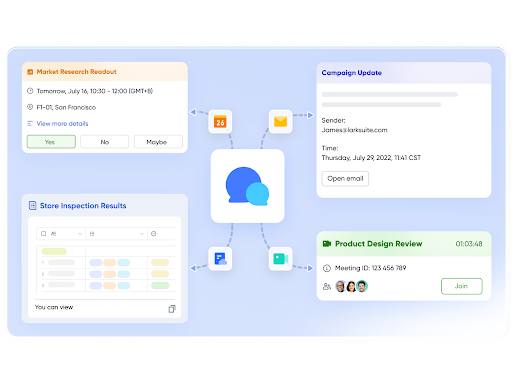
Automation often gets mistaken for impersonal. In reality, it works best when it strengthens human connection—and that’s what Lark Messenger does.
Lark Messenger ensures that automated alerts, updates, and system triggers are delivered where people already collaborate. When a process runs in Lark Base or a milestone completes, Lark Messenger brings that context directly into conversation. It’s not just a notification feed—it’s a living workspace where action and discussion happen side by side.
Imagine a sales manager receiving an alert that a client’s onboarding checklist is complete. Instead of opening another platform, they respond right inside Lark Messenger, tagging the account lead to prepare next steps. Communication flows naturally, powered by automation but anchored in human context.
Lark Messenger makes sure the “human touch” never gets lost—automation drives progress, but people still drive direction.
Lark Tasks: Turning automation into accountability
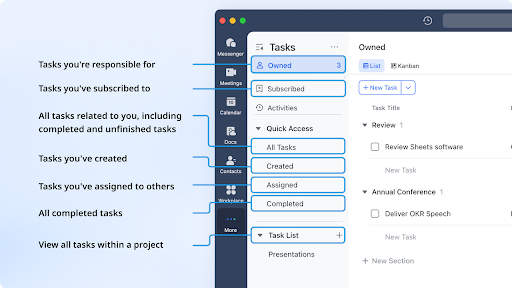
Automation removes repetition, but progress still depends on ownership. Lark Tasks ensures that when workflows trigger automatically, accountability remains crystal clear.
When Lark Base updates or Lark Messenger alerts fire, Lark Tasks generates new deliverables with assigned owners, due dates, and links back to their origin. A customer escalation logged in Lark Base can instantly become a task for the support lead, while the related documentation or client feedback stays attached for full transparency.
Each task evolves with live progress updates that sync back to Lark Base. Managers don’t need to ask for status reports—they can see them unfold in real time. However, when syncing task lists to Lark Base, updates are automatically synced every hour. You can also manually sync the latest data if needed. Lark Tasks connects automation with action, ensuring that every automated process still ends with a human who owns the outcome.
This blend of structure and flexibility turns automation from an invisible force into a visible system of accountability.
Lark Sheets: Making automation measurable
Smart work isn’t just about getting things done faster—it’s about understanding what’s working. Lark Sheets bridges that insight gap by connecting live data from automated processes into clear, collaborative dashboards.
By setting up a webhook trigger in Base automations, Lark Sheets syncs with Lark Base, meaning every completed task, client update, or workflow trigger reflects immediately in the data. Teams can visualize their efficiency gains—how much faster projects move, where bottlenecks appear, or which automations save the most time.
During review sessions, teams can discuss performance directly in Lark Sheets. Leaders comment beside key figures, propose optimizations, and assign follow-up actions without exporting a single file. Lark Sheets turns data into dialogue, helping teams refine their systems continuously.
Automation becomes measurable, not mystical—every improvement backed by transparent numbers.
Lark Meetings: When discussions drive smarter systems
Even in automated environments, some conversations need a human touch. Lark Meetings ensures those moments feed directly back into the workflow instead of becoming isolated discussions.
During a strategy session, teams can open live Lark Base dashboards to analyze automation performance, review Lark Sheets to see impact metrics, and update Lark Docs or Lark Tasks as decisions are made. By the time the meeting ends, things discussed are already in motion—synced across tools via automation, manual follow-up or setup.
Meetings stop being moments of interruption and become catalysts for refinement. Teams review, improve, and relaunch workflows without waiting on follow-ups. It’s a cycle of continuous improvement—automation enhanced by insight, not hindered by it.
Lark Wiki: Documenting the logic behind the automation
Automation works best when everyone understands how and why it operates. Lark Wiki gives teams a central place to document processes, logic rules, and best practices so that automation doesn’t become a mystery. Teams can write clear guides explaining each workflow—what triggers it, what steps it performs, and how exceptions are handled.
This living documentation ensures sustainability. New employees can learn existing workflows in minutes, and process owners can update information without starting over. Lark Wiki makes automation a shared language, turning operational intelligence into accessible knowledge.
Bringing it together: The connected flow of work
What makes automation powerful in Lark is not any single feature, but how they flow together. A new lead arrives through the CRM; Lark Base captures it; an automated workflow sends an alert in Lark Messenger and creates Lark Tasks for follow-up; progress updates appear in Lark Sheets; results are reviewed in Lark Meetings; and the entire process gets documented in Lark Wiki.
Each step happens seamlessly, guided by context rather than commands. Teams don’t think about systems—they think about solutions. Work becomes smoother, quieter, and smarter.
Automation in Lark isn’t just about saving time; it’s about shaping better habits—eliminating repetitive steps so people can invest their energy in creative, high-impact work.
Conclusion
Automation’s real value isn’t efficiency for its own sake—it’s the freedom it gives people to think strategically, innovate faster, and collaborate meaningfully. A CRM app may organize customer data, but connected platforms like Lark ensure those insights translate into outcomes.
With Lark Base driving automation, Lark Messenger connecting teams in real time, and Lark Tasks maintaining accountability, workflows move effortlessly from one stage to the next. Lark Sheets gives visibility, Lark Meetings ensures alignment, and Lark Wiki preserves knowledge. Together, they form a living ecosystem of progress—one where effort decreases but impact grows.
In the modern world, success belongs to systems that think for themselves and teams that think beyond the manual. Lark represents the new generation of project management tools—not just built to organize work, but to orchestrate it intelligently.
Because the smartest work isn’t done faster—it’s done better, through connection.